
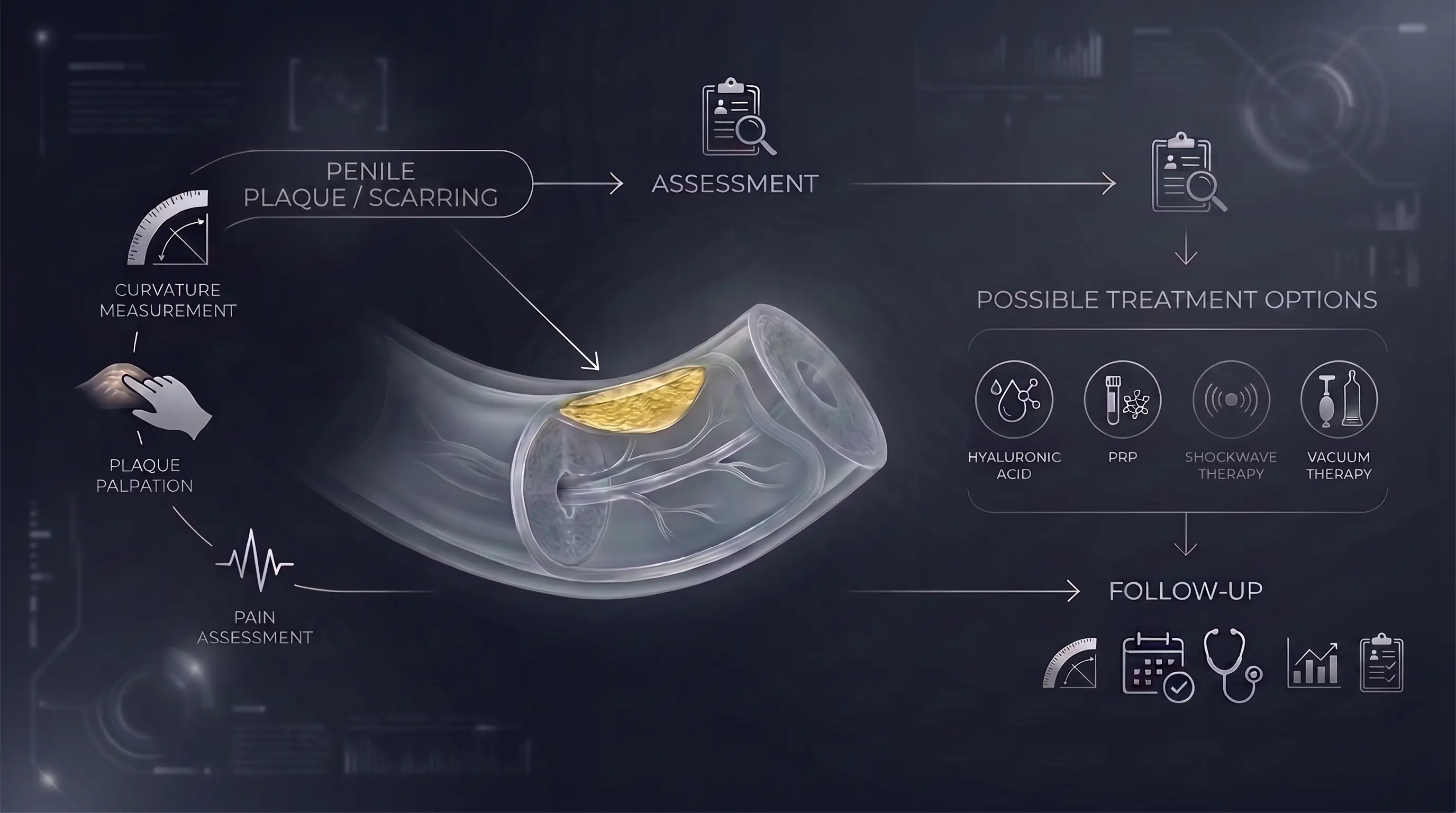
A hard area in the penis, painful erection or new curvature can be signs of Peyronie’s disease. Learn what penile scarring and plaque mean and when to seek assessment.
A hard area in the penis can be alarming — particularly when it is accompanied by a new bend, painful erection or change in shape.
One possible cause is Peyronie’s disease, where fibrous scar tissue develops within the tissues surrounding the erectile chambers of the penis.
This scar tissue is commonly called a Peyronie’s plaque.
But what exactly is a penile plaque, why does it cause curvature, and does every plaque need treatment?
What Is a Peyronie’s Plaque?
A Peyronie’s plaque is an area of abnormal fibrous scar tissue, usually developing within the tunica albuginea — the strong tissue surrounding the erectile bodies of the penis.
Normal penile tissue stretches during an erection.
Scarred tissue is less flexible.
If one area cannot stretch normally while the surrounding tissue does, the penis may pull towards the affected side and create a curved or bent erection.
The NHS describes Peyronie’s disease as causing a hardened area or scar within the penis that can lead to curvature, painful erections, shortening, narrowing and sometimes erectile dysfunction.
What Can Penile Scarring Feel Like?
Patients describe penile scarring in different ways.
Possible signs include:
- a firm or hard lump within the penile shaft;
- a flat area of thickening rather than a distinct lump;
- new penile curvature during erection;
- painful erections;
- shortening or narrowing of the penis;
- an indentation or hourglass deformity;
- difficulty with penetration;
- problems getting or maintaining an erection.
Importantly, the size of a plaque does not necessarily predict how much curvature a man will have. A relatively small area of scarring can sometimes produce considerable deformity depending on its position and how it affects the surrounding tissue.
Does Penile Scarring Always Mean Peyronie’s Disease?
Not necessarily.
A normal penis may have a mild natural curve, and not every lump or change in shape is Peyronie’s disease.
However, a new hard area, changing curvature, painful erections or shortening deserves medical assessment, particularly if the change developed during adulthood.
The NHS advises seeking medical help for swelling or a hard penile lump, significant new curvature, painful erections or associated erectile dysfunction.
This is important because treatment decisions depend not only on whether a plaque is present, but also on which stage of Peyronie’s disease the patient is in.
Stages of Peyronie’s Disease: Active vs Stable
Peyronie’s disease generally develops through two clinical stages.
During the active phase, the plaque and deformity may still be evolving. Men may experience penile pain, a changing curve or a recent alteration in shape.
The condition later enters a stable phase, where pain usually settles and the curvature stops changing.
European urology guidance considers resolution of pain and stability of curvature for at least three months useful signs that the disease has stabilised. Distinguishing active from stable disease is important because it influences conservative treatment and the timing of surgery.
This is one reason why seeking assessment relatively early can be useful rather than waiting until the deformity becomes severe.
Can a Peyronie’s Plaque Cause Erectile Dysfunction?
Yes.
Peyronie’s disease and erectile dysfunction can occur together.
There may be several reasons.
Significant curvature can make penetration mechanically difficult. Pain may interfere with sexual activity. Some men also develop anxiety around erections or intercourse.
Other patients already have vascular erectile dysfunction, diabetes or cardiovascular risk factors alongside Peyronie’s disease.
The EAU therefore recommends assessing erectile function as part of the initial Peyronie’s evaluation rather than viewing the plaque in isolation.
Does a Penile Plaque Need Treatment?
Not always.
If someone has mild Peyronie’s disease, little or no pain and a curvature that does not interfere with sexual function, active treatment may not be necessary.
Treatment becomes more relevant when there is:
persistent pain, progressive curvature, difficulty with intercourse, significant shortening or deformity, erectile dysfunction, or substantial distress.
The appropriate treatment also depends heavily on whether the disease is active or stable.
What Treatments Are Available for Peyronie’s Disease?
There is no single treatment suitable for every plaque.
Management may involve observation, treatment of pain, medication for associated erectile dysfunction, penile traction or vacuum-device therapy, selected injectable treatments and, for more severe stable deformity, surgery.
European guidance allows vacuum or traction devices as part of conservative or multimodal treatment, although the available evidence remains limited. It also recognises intralesional hyaluronic acid as a possible option in selected patients with acute-phase Peyronie’s disease, while noting that outcome data are still developing.
For stable disease where curvature significantly interferes with sexual intercourse, surgery may be considered after appropriate specialist assessment.
Can a Peyronie’s Plaque Change With Treatment?
A Peyronie’s plaque is not simply a lump that can be massaged away. It represents altered fibrous scar tissue within the penis.
There is growing interest in injectable treatments aimed at modifying the symptoms and tissue changes associated with Peyronie’s disease, including hyaluronic acid and platelet-rich plasma (PRP).
PRP is prepared from the patient’s own blood and contains concentrated platelets and biological factors involved in normal tissue repair. In Peyronie’s disease, PRP has been investigated as an injection directly into or around the penile plaque.
At Healing-PRP Clinics, we have also used intraplaque PRP in selected patients. Two patients treated so far have reported an improvement in their symptoms following treatment.
However, these are only early individual observations. They do not establish that PRP caused the improvement or that PRP can reliably reduce plaque, straighten curvature or improve symptoms in other patients.
Current European guidance acknowledges encouraging early data for intralesional PRP but emphasises that the clinical evidence remains limited. Larger, well-controlled studies are still required before its effectiveness can be established.
We are also observing selected patients receiving hyaluronic acid injections alongside vacuum therapy, and we discuss those early findings separately in our article on Hyaluronic Acid Injections for Peyronie’s Disease.
Low-intensity shockwave therapy may also be considered in selected patients, particularly during the active phase to help reduce penile pain, although it has not been shown reliably to reduce plaque size or correct curvature.
When Should You Have a Penile Plaque Checked?
A new change in the penis should not automatically be ignored because it feels embarrassing.
Assessment is particularly worthwhile if you notice a new penile lump or scar, increasing curvature, painful erections, shortening, hourglass narrowing or erectile difficulties.
A proper Peyronie’s assessment should consider the duration of symptoms, pain, plaque location, degree of curvature, erectile function and whether the disease appears active or stable.
The aim is not simply to identify the plaque.
It is to understand what the scar tissue is doing to the penis and whether treatment is actually needed.
Penile Scarring Deserves a Proper Assessment
A Peyronie’s plaque can be small but still have a significant effect on curvature, erections and confidence.
Equally, some men with mild, stable disease may need little more than monitoring.
The important questions are:
Is the disease still changing? Is it painful? Is the curvature affecting sexual function? And what treatment strategy is appropriate at this stage?
At Healing-PRP Clinics, Peyronie’s disease consultations are private and doctor-led, with assessment of symptoms, plaque, curvature and erectile function before treatment options are discussed.
If you have noticed new penile scarring, a hard plaque, painful erections or increasing curvature, a confidential assessment can help clarify what may be happening and which options may be appropriate.
Treatment outcomes vary. Peyronie’s disease treatment should be based on individual assessment, disease stage, symptoms and functional impact.
Explore Peyronie’s Disease Treatment at Your Nearest Clinic
Healing-PRP Clinics provides private, doctor-led assessment and treatment planning for Peyronie’s disease at:
- Peyronie’s disease treatment in Hampstead, London
- Peyronie’s disease treatment in Birmingham
- Peyronie’s disease treatment in St Albans
References
- European Association of Urology — Sexual and Reproductive Health Guidelines: Penile Curvature and Peyronie’s Disease.
- NHS — Peyronie’s Disease.
- British Association of Urological Surgeons — Peyronie’s Disease Patient Information.