
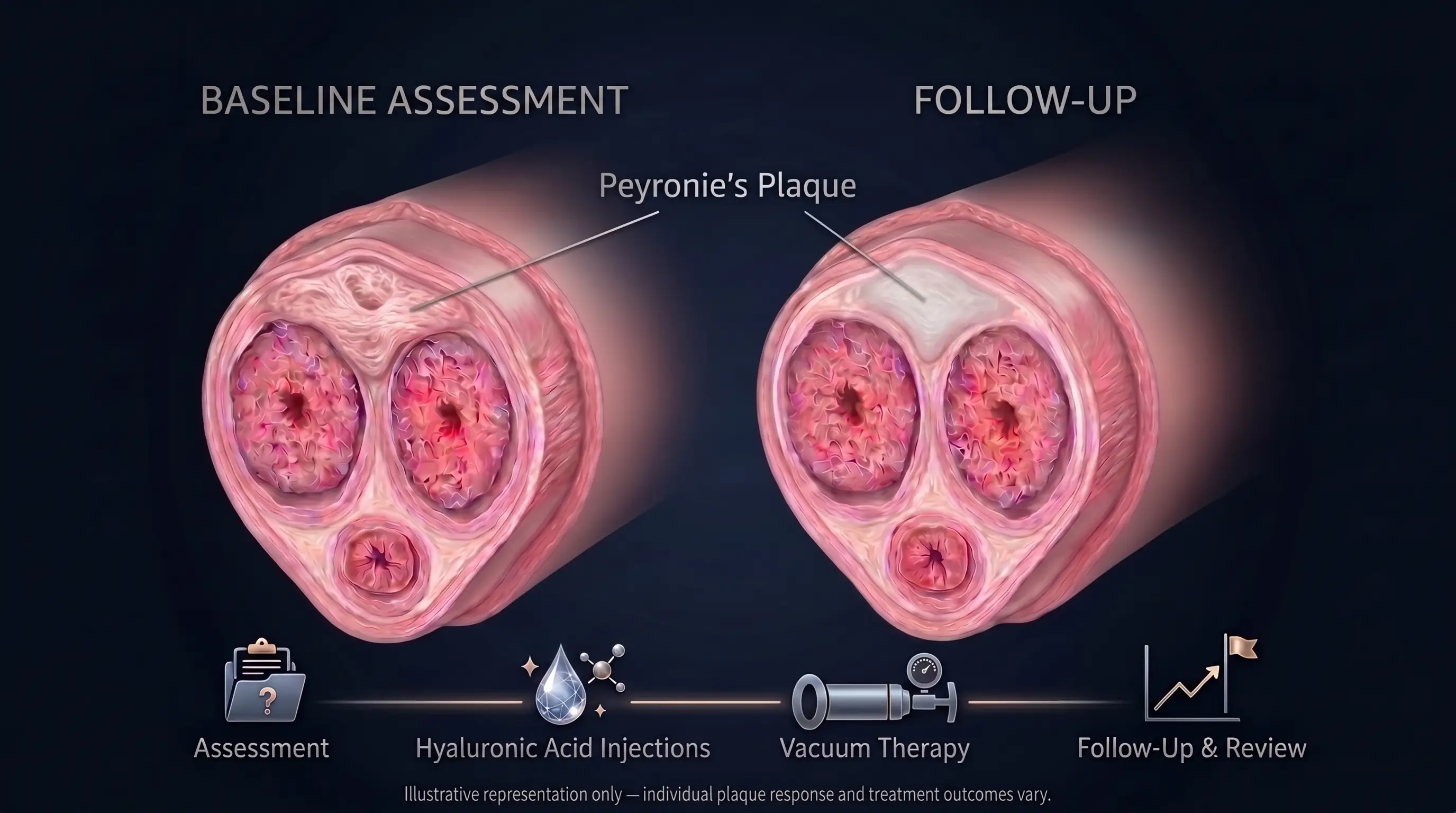
Hyaluronic acid injections are an emerging option in Peyronie’s disease treatment. We review current evidence, the role of vacuum therapy and our early clinical observations in active and stable disease.
Can a Peyronie’s plaque change with treatment — and is there an advantage to treating the condition while it is still active? These are questions we are beginning to explore in clinical practice. At Healing-PRP Clinics, we have recently treated a small number of patients with intra-plaque hyaluronic acid injections, alongside vacuum-device therapy where clinically appropriate. Our experience is still very early, so these observations should not be interpreted as proof that the treatment works. However, what we have seen so far is interesting when considered alongside the developing clinical evidence.
Active vs Stable Peyronie’s Disease
Peyronie’s disease develops when fibrous scar tissue forms within the penis, producing a palpable plaque and potentially causing curvature, shortening, pain and erectile difficulties. During the active phase, pain and penile curvature may still be changing. In the stable phase, pain often settles and the curvature has generally stopped progressing.This distinction matters because current European Association of Urology guidance now allows intra-lesional hyaluronic acid, alone or with other treatments, as an option to reduce pain and/or curvature in acute-phase Peyronie’s disease, while acknowledging that the available outcome data remain limited.
What Have We Observed So Far?
Our experience currently involves only three patients. One patient had active Peyronie’s disease with penile pain. Following treatment, he reported:
- reduced pain;
- a slight subjective improvement in curvature.
The other two patients had established, stable disease with clearly palpable plaques. After four hyaluronic acid injections, the plaques appeared somewhat less firm on clinical palpation. This is an observation rather than a proven treatment effect. Plaque firmness assessed by touch is subjective, and we are not claiming that hyaluronic acid dissolves or reliably softens Peyronie’s plaques. However, it raises an interesting question about whether tissue characteristics may change during treatment and whether selected patients with established disease could potentially benefit.
What Does the Research Say?
Research into hyaluronic acid for Peyronie’s disease is still developing. A 2025 systematic review examining injection therapy during the acute phase included 20 studies and more than 1,200 patients. Improvements in curvature and pain were reported in many studies, but the researchers highlighted substantial variation between treatment methods and overall low-to-intermediate evidence quality. Randomised research has also reported reductions in curvature and pain following intra-lesional hyaluronic acid in acute disease, although larger and longer-term studies are still needed. The current EAU guideline therefore gives hyaluronic acid a weak recommendation for acute-phase disease, rather than presenting it as an established cure.
What About the Penis Pump?
All three of our patients are also using a vacuum erection device, commonly called a penis pump, as part of their treatment programme. This is important because any improvement cannot automatically be attributed to the injections alone. Vacuum therapy gently expands penile tissues using negative pressure and may form part of a multimodal Peyronie’s treatment strategy. Current European guidance states that vacuum or penile traction devices may be offered to reduce penile deformity or as part of combined treatment, although the evidence remains limited. Published hyaluronic-acid treatment protocols have also combined injections with regular vacuum therapy and penile modelling. The device should always be used according to medical advice. Excessive vacuum pressure can cause bruising, pain or injury.
The Treatment Is More Than an Injection
Peyronie’s disease treatment is rarely about one procedure alone. For selected patients, the strategy may involve: medical assessment → hyaluronic acid injections → vacuum therapy → home care → follow-up and reassessment. The doctor’s role is to assess the stage of disease, document the plaque and curvature, discuss realistic expectations and monitor progress. The patient’s role is equally important: following the treatment programme consistently, using the vacuum device correctly and reporting changes in pain, curvature or erectile function.
Early Observations, Not Final Conclusions
Our first clinical observations are encouraging. One patient with active disease has reported less pain and a slight improvement in curvature. Two patients with established plaques have shown a subjective reduction in plaque firmness after four injections. But three patients are far too few to establish effectiveness.Peyronie’s disease behaves differently between individuals, and all three patients are also using vacuum therapy. Objective follow-up — including curvature measurements, pain scores and patient-reported outcomes — will therefore be important as our experience grows.
What we can say is that hyaluronic acid is becoming an increasingly interesting area of Peyronie’s disease treatment, particularly during the active phase, and current European guidance now recognises it as a possible conservative option in selected patients. At Healing-PRP Clinics, Peyronie’s disease treatment is doctor-led and provided following individual assessment and discussion of the available evidence, limitations and alternatives.
If you have new penile curvature, painful erections or an established Peyronie’s plaque, a confidential consultation can help determine which treatment options may be appropriate. These clinical observations involve only three patients and should not be interpreted as evidence of effectiveness or a guarantee of outcome. Hyaluronic acid treatment for Peyronie’s disease remains an evolving area of evidence, particularly outside the active phase.
Book Confidential Consultation or Learn More: Birmingham Clinic
St Albans, Hertfordshire Clinic References
- European Association of Urology — Guidelines on Penile Curvature and Peyronie’s Disease.
- Manfredi C et al. Injection therapy in the acute phase of Peyronie’s disease: a systematic review of current evidence. Journal of Sexual Medicine, 2025.
- Clinical trial comparing intralesional hyaluronic acid with verapamil in acute-phase Peyronie’s disease.
- EAU Patient Information — traction and vacuum devices for penile curvature.